Growing guide
How to Grow Marshmallow Root From Seed (Stratify It, and Keep It Wet)
Marshmallow is one of the three genuinely difficult species in this kit, and it fails in two predictable ways: sown without cold treatment, and planted somewhere too dry.
By Sohail Akhtar · Updated 25 August 2026 · Althaea officinalis · Perennial
Difficulty
Hard
Germination
14–28 days, erratic
Sow depth
6 mm (1/4 in)
First flowers
Roots usable from year two onward
Spacing
45–60 cm (18–24 in)
Sun
Full sun to part shade
Why marshmallow germinates so unevenly
Althaea officinalis is a temperate perennial with a hard seed coat and a dormancy mechanism that expects a winter. Sown straight into warm spring soil, germination is slow, patchy and often disappointing — 14 to 28 days at best, with large gaps.
Three to four weeks of cold, moist stratification in the refrigerator markedly improves both the rate and the evenness. This is the same treatment echinacea and lavender need, and it is why three of the ten species in this kit share a single technique.
Some growers also nick or lightly abrade the seed coat before stratifying, which can help water penetrate. It is fiddly with small seed and stratification alone is usually enough.
- Dampen sand or a paper towel until barely moist — squeezed hard, no water should run out.
- Mix the seed through it and seal in a labelled bag or container.
- Refrigerate at roughly 1–5°C (34–40°F) for three to four weeks. Not the freezer.
- Check weekly for mould, then sow at about 6 mm (1/4 in) deep.
It is a wet-meadow plant, and that matters
This is the detail the sales copy tends to skip. Marshmallow grows naturally in damp meadows, ditches and salt marsh margins. It is not a plant for a dry sunny border, and treating it as one is the second reliable way to fail with it.
Give it the dampest part of your garden, or somewhere you are willing to water consistently. It tolerates heavy soil that other herbs would resent, and it copes with some salt, which is a legacy of its coastal habitat.
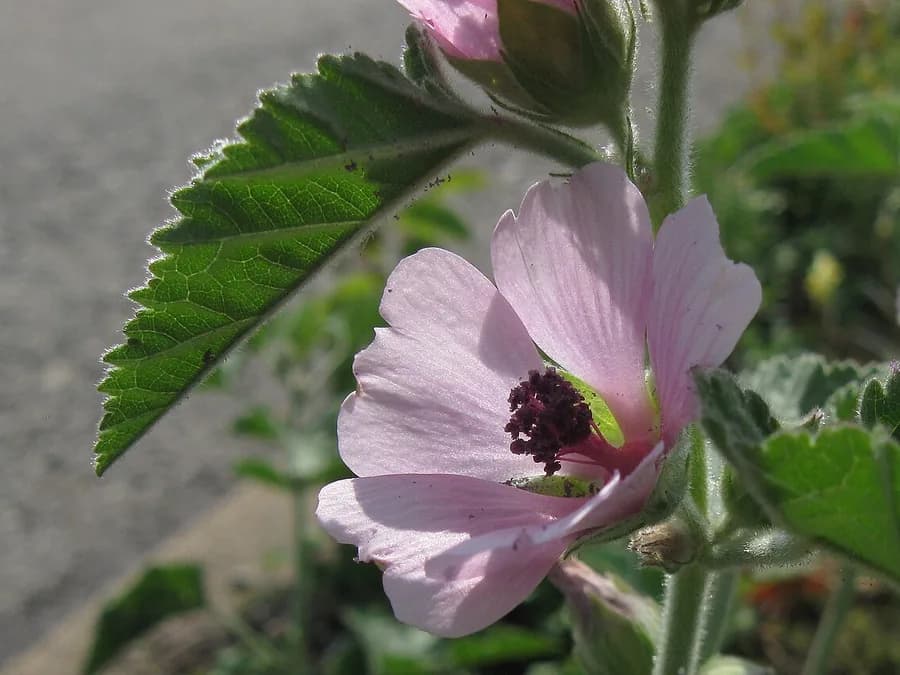
Full sun to part shade both work. Space plants generously — roughly 45–60 cm (18–24 in) — because an established plant becomes large, reaching well over a metre with soft, downy, grey-green leaves and pale pink flowers.
Timing and the first two years
Working backwards: stratification takes three to four weeks, and seedlings want six to eight weeks before going out. Start the cold treatment roughly ten to twelve weeks before your last frost.
The simpler alternative, as with the other stratifying species, is to sow directly outdoors in late autumn and let winter do the work. Less control, less effort, frequently better results.
Marshmallow is slow in year one and builds size and root mass rather than performing. The root is not worth lifting until year two at the earliest, and year three gives noticeably more.
- Ten to twelve weeks before last frost: seed goes into the refrigerator.
- Six to eight weeks before last frost: sow the stratified seed, 6 mm deep.
- After frost: harden off and plant out 45–60 cm apart in damp ground.
- Alternative: sow outdoors in late autumn and skip the refrigerator entirely.
Harvesting the root
If you want root, lift in autumn of year two or later, once the top growth has died back and the plant has moved its resources downward. Younger roots are thin and give very little for the effort.
Dig widely around the plant rather than pulling — the root system is substantial and brittle. Wash thoroughly, slice while fresh because it becomes very hard when dry, and dry the slices completely somewhere airy.
You can lift part of a clump and leave the rest to keep growing, which is the sensible approach with a plant that took two years to get there.
Traditional use, stated carefully
The mucilaginous root has been used traditionally as a soothing preparation, and the plant is the original source of the confection that still carries its name — modern marshmallows contain no Althaea at all.
That history is not clinical evidence, and nothing on this page should be read as a claim that marshmallow treats, prevents or cures anything. Its mucilage content means it can affect how other medicines are absorbed; speak to a qualified healthcare provider before using any plant preparation.