Growing guide
How to Grow Feverfew From Seed (And How to Stop It Taking Over)
Feverfew is easy to grow and easy to end up with far too much of. The skill with this plant is not germination — it is containment.
By Sohail Akhtar · Updated 25 August 2026 · Tanacetum parthenium · Short-lived perennial
Difficulty
Easy
Germination
10–14 days
Sow depth
Surface sow — needs light to germinate
First flowers
Usually flowers in year one if sown early
Spacing
30 cm (12 in)
Sun
Full sun to light shade
Where to plant feverfew
Decide this before you sow, because it is the decision that matters most. Feverfew self-seeds enthusiastically, and wherever you put it is roughly where it will be for years. Choose a spot where volunteers are welcome rather than a carefully composed border.
It wants full sun to light shade and well-drained soil, and it is genuinely unfussy beyond that. Poor, dry, stony ground suits it. Rich damp soil produces taller, softer plants that flop.
A gravel path edge, a bank, or an informal corner suits it better than a bed you intend to keep controlled. Some gardeners grow it in containers purely to stop it spreading.
Sowing: surface sow, like chamomile
Feverfew seed needs light to germinate. Press it onto the surface of moist compost and leave it uncovered, exactly as you would with chamomile. Do not rake it in.
Expect seedlings in roughly 10 to 14 days. Sown early enough — indoors six to eight weeks before your last frost — feverfew usually flowers in its first year, which is unusual for a perennial and one of the reasons people like it.
Direct sowing outdoors in spring works too, though the plants will be later to flower.
- Six to eight weeks before last frost: surface sow indoors for first-year flowers.
- Spring, after frost: direct sow onto a raked, damp surface. Do not cover.
- Thin or space to about 30 cm (12 in) apart.
- Seedlings appear in roughly 10–14 days.
How to identify feverfew
Feverfew is easy to confuse with chamomile at a glance, and both are in this kit, so it is worth being able to tell them apart.
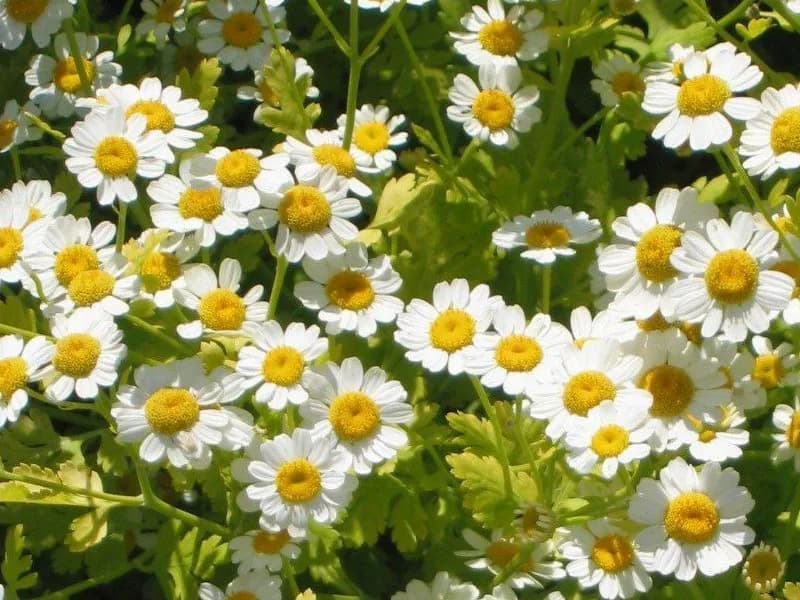
The leaves are the reliable difference. Feverfew has broader, flatter, yellowish-green leaves with rounded lobes — they look almost like small chrysanthemum leaves. German chamomile has very fine, thread-like, feathery foliage.
The flowers help too. Feverfew produces clusters of small white daisies with a flat yellow centre and short, stubby petals, held in loose bunches. Chamomile flowers are carried more singly and have a distinctly domed, hollow centre. Feverfew also has a strong, bitter, slightly acrid smell when the leaves are crushed, which chamomile does not.
Keeping it in bounds
One feverfew plant produces a great deal of seed, and the following spring you will find seedlings some distance from where you sowed. This is the single thing gardeners complain about with this species.
The fix is straightforward if you are disciplined: cut the flower heads off as they finish, before the seed ripens. That alone prevents most of the spread. Pulling unwanted seedlings is easy — they come up shallow-rooted and in obvious clusters.
Feverfew is short-lived as a perennial, typically lasting two to three years before declining. Ironically, the self-seeding that makes it a nuisance is also what keeps a patch going, so most gardeners let a few heads set seed deliberately.
Traditional use, stated carefully
Feverfew has a long documented history in European herbal tradition, where the leaves were used for headaches. It is one of the better-recorded plants in that tradition.
That history is not the same thing as clinical evidence, and nothing on this page should be read as a claim that feverfew treats, prevents or cures anything. Feverfew is in the daisy family and can cause mouth irritation and allergic reactions; it is also not considered suitable during pregnancy. Speak to a qualified healthcare provider before using any plant preparation.