Growing guide
How to Grow Evening Primrose From Seed (Year One Is Leaves Only)
This is the most commonly misdiagnosed failure in the whole kit. Evening primrose does exactly what it is supposed to do in year one, and what it is supposed to do looks like nothing.
By Sohail Akhtar · Updated 25 August 2026 · Oenothera biennis · Biennial
Difficulty
Moderate
Germination
14–21 days
Sow depth
Surface to 3 mm — light aids germination
First flowers
Flowers in year TWO, not year one
Spacing
30–45 cm (12–18 in)
Sun
Full sun, well-drained
It is a biennial. That is the whole story.
Oenothera biennis takes two years to complete its life cycle, and the botanical name says so. In year one it germinates and forms a flat rosette of leaves close to the ground. That is all it does, all season, and it is entirely correct behaviour.
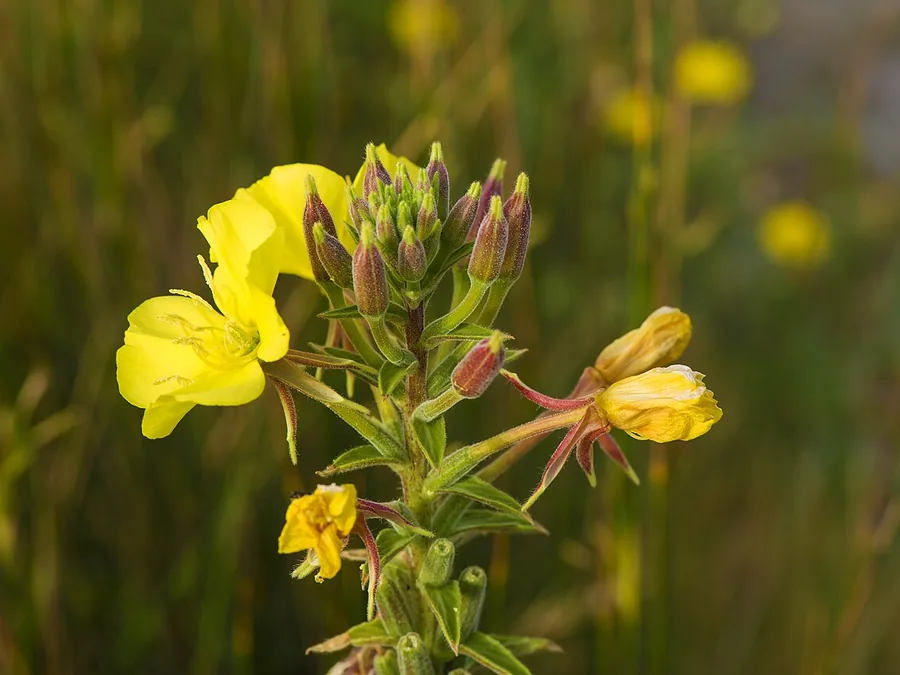
In year two the plant sends up a tall flowering spike — often well over a metre — carrying yellow four-petalled flowers that open at dusk, sets seed, and dies.
Gardeners who expect flowers in the first summer conclude the seed was bad or the plant failed, and pull it out a few months before it would have delivered. If you take one thing from this page, take that.
Sowing evening primrose
The seed is small and light aids germination, so sow shallowly — on the surface or barely covered to about 3 mm. Do not bury it.
It germinates readily without any special treatment, usually in 14 to 21 days. A short cold, moist period improves consistency but is optional, unlike echinacea, lavender and marshmallow where it makes a real difference.
Sow in spring for a rosette that overwinters and flowers the following summer, or in late summer or early autumn, which is closer to how the plant seeds itself naturally. Direct sowing is preferable — evening primrose forms a taproot and is happier not being moved.
- Sow on the surface or barely covered, no deeper than 3 mm.
- Direct sow where plants are to grow — the taproot dislikes disturbance.
- Spring or late summer both work. Late summer mirrors natural self-seeding.
- Seedlings appear in roughly 14–21 days. Space 30–45 cm (12–18 in) apart.
Getting flowers every year
There is a simple trick to a biennial, and it is to sow in two consecutive years. Sow this year and next year, and from the second year onward you will always have one cohort flowering while another is building its rosette.
After that the plant usually handles it itself. Evening primrose self-seeds freely, and an established patch generally sustains overlapping generations without further help.
If you want to guarantee it, leave the seed pods on the plant to ripen and split rather than cutting the spent stems down tidily.
Where it grows and how big it gets
Evening primrose is undemanding to the point of being weedy. It wants full sun and well-drained soil, and it grows happily on poor, sandy, disturbed ground — which is where you will most often see it growing wild.
Rich soil produces tall, soft plants that need staking. Poor soil produces sturdier ones. It is drought-tolerant once the taproot is down.
Plan for the height. A flowering plant commonly reaches 1–1.5 m and looks gawky in a formal border. It is better suited to the back of an informal bed or a wild corner, where the dusk-opening flowers are worth watching for — they unfurl visibly over a few minutes on a summer evening, which is genuinely worth catching once.
Traditional use, stated carefully
The seed oil has a long history of traditional use, and the plant has an equally long record of use among Indigenous peoples of eastern North America, where it is native. The flowers open at dusk, which gives the plant its name.
Extracting usable oil from the seed is an industrial process, not something achievable in a home kitchen, so a packet of seed is a gardening proposition rather than a route to a supplement. Nothing on this page should be read as a claim that evening primrose treats, prevents or cures anything, and it can interact with some medications. Speak to a qualified healthcare provider before using any plant preparation.