Growing guide
How to Grow Chicory From Seed (Check Your Region First)
Chicory germinates in a week, tolerates drought, and comes back for years. Those same qualities are why it has naturalised across much of North America, so the first step here is not sowing.
By Sohail Akhtar · Updated 25 August 2026 · Cichorium intybus · Perennial
Difficulty
Easy
Germination
7–14 days
Sow depth
6 mm (1/4 in)
First flowers
Roots in autumn of year one; fuller in year two
Spacing
15–20 cm (6–8 in)
Sun
Full sun
Check whether chicory is a problem where you live
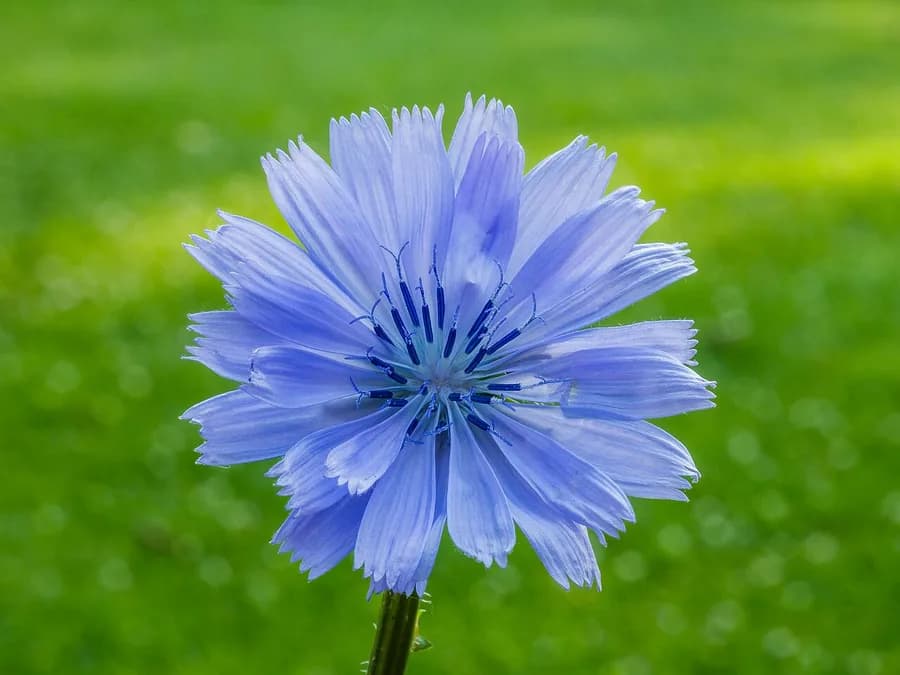
Chicory is native to Europe and has naturalised widely elsewhere, including across much of the United States, where you will see its sky-blue flowers along roadsides all summer. In some regions it is listed as a noxious or invasive species.
This is not a reason to avoid it everywhere. It is a reason to spend two minutes checking your state or county's noxious weed list, or your local extension service, before you plant it out. That check costs nothing and is the responsible thing to do with any vigorous naturalising species.
If it is a problem locally, grow it in a container and deadhead before seed sets, or skip this packet. Neither ruins the kit.
Direct sow — chicory will not transplant
Chicory forms a deep taproot very early, and like California poppy it strongly resents being moved. Seedlings started in modules and transplanted out usually check badly or die outright.
Sow it where it is going to stay. Prepare the ground to a reasonable depth if you want a good root, since a stony or compacted bed produces forked, stunted taproots.
Sow at about 6 mm (1/4 inch) in spring once the soil has warmed, or in late summer for an autumn crop. Expect seedlings in 7 to 14 days — chicory germinates fast and reliably.
- Prepare a bed with reasonable depth and no large stones.
- Sow 6 mm (1/4 in) deep, directly where plants are to grow.
- Thin to about 15–20 cm (6–8 in) apart for roots, wider for flowering plants.
- Seedlings appear in 7–14 days.
Growing on
Chicory needs very little once it is up. Full sun, ordinary soil, and no particular attention. It is genuinely drought tolerant after the first few weeks, and it survives cold that kills most of the other plants in this kit.
In its first summer it produces a rosette of toothed leaves that look much like a dandelion's, which is a common source of confusion. The taproot develops beneath. In year two it sends up tall, wiry, sparsely leaved stems carrying the sky-blue flowers.
Those flowers open in the morning and close by early afternoon, and each individual bloom lasts a single day. The plant keeps producing new ones over a long season.
Harvesting the root
The taproot is what most people grow chicory for. Lift it in autumn of the first year, once the plant has had a full season to build it — roots left to a second year get larger but also woodier and more fibrous.
Dig rather than pull. The root goes down further than you expect and snaps easily, and a broken root left in the ground will regrow.
Scrub, slice and dry the root thoroughly, then roast it if you intend to use it as a coffee substitute. Roasting is what produces the dark, bitter, faintly sweet character it is known for; unroasted dried root tastes quite different.
Traditional use, stated carefully
The roasted root has been used historically as a coffee substitute and extender, particularly in Europe during wartime shortages and in the American South, where the practice persists in New Orleans coffee to this day. The young leaves have also been eaten as a bitter salad green.
Those are culinary and historical uses. Nothing on this page should be read as a claim that chicory treats, prevents or cures anything.