Growing guide
How to Grow German Chamomile From Seed (Do Not Bury It)
Chamomile is one of the fastest and most generous plants in this collection, and there is exactly one way to get it wrong: covering the seed.
By Sohail Akhtar · Updated 25 August 2026 · Matricaria recutita · Annual
Difficulty
Easy
Germination
7–14 days
Sow depth
Surface sow — needs light to germinate
First flowers
Flowers in roughly 8–10 weeks
Spacing
15–20 cm (6–8 in)
Sun
Full sun to light shade
The one mistake that ruins chamomile
German chamomile seed requires light to germinate. Sow it at the depth the back of most seed packets suggests and it will barely come up at all.
The seed is extremely fine — closer to dust than to anything you can pick up individually — and it needs to sit on the surface where light reaches it. Press it into contact with moist compost and leave it there uncovered.
That creates the second problem, which is the only genuinely fussy thing about this plant: surface-sown seed dries out fast. A seedbed that dries between waterings kills germinating chamomile quickly, and it is the reason people who did everything else right still end up with an empty tray.
- Sow on the surface. Do not cover with compost.
- Press gently so the seed makes contact, then water from below or with the finest possible spray.
- Cover the tray with a clear lid, glass or a propagator top until seedlings appear.
- Never let the surface dry out during the 7–14 day germination window.
When to sow chamomile
German chamomile is a true annual, so there is no cold period to arrange and no year-two wait. It flowers roughly eight to ten weeks from sowing.
Sow indoors four to six weeks before your last frost if you want the earliest flowers, or direct sow outdoors once frost has passed. Outdoors, scatter the seed on a raked, moist surface and resist the urge to rake it in.
Because it flowers so quickly, a second sowing three or four weeks after the first extends the picking season considerably.
- Four to six weeks before last frost: sow indoors on the surface of moist compost.
- After last frost: direct sow onto a prepared, damp seedbed. Do not cover.
- Three to four weeks later: sow again for a longer flowering run.
German or Roman? They are different plants
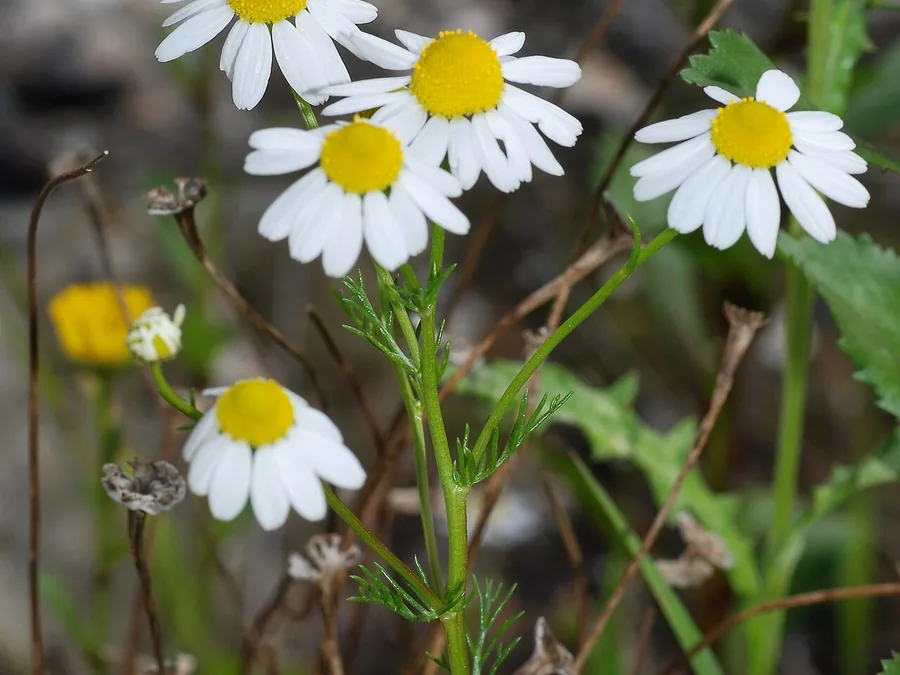
This causes real confusion, and the two are not interchangeable. German chamomile, Matricaria recutita, is the annual in this kit — an upright, branching plant reaching perhaps 60 cm, with small white-and-yellow daisy flowers and a hollow, domed centre.
Roman chamomile, Chamaemelum nobile, is a low-growing perennial used as ground cover and in chamomile lawns. It has a solid flower centre rather than a hollow one, and it spreads rather than standing upright.
Growing advice written for one does not reliably apply to the other. If a guide tells you chamomile is perennial and mat-forming, it is describing Roman chamomile, not the plant in this packet.
Growing on and harvesting
Once germinated, chamomile is undemanding. Full sun to light shade, ordinary soil, moderate water. It does not want rich ground, and overfeeding produces soft growth and fewer flowers.
Thin or space plants to roughly 15–20 cm apart. Crowded chamomile still flowers but is more prone to mildew and harder to pick from.
Pick the flowers when the white petals are fully open and horizontal, before they begin to reflex backward and the centre darkens. Pick often — like calendula, the plant flowers harder the more you take. Dry the heads in a single layer somewhere airy and out of direct sun.
Self-seeding
Left to finish, chamomile sets seed prolifically and returns on its own the following year. In a bed it suits, one sowing is usually the only one you will ever make.
That is convenient if you want a permanent chamomile patch and mildly inconvenient otherwise. Pulling volunteers is easy — the roots are shallow and the seedlings come up in obvious drifts.
Traditional use, stated carefully
The dried flowers have been taken as a calming tea across European folk tradition for centuries, and chamomile is one of the most widely recognised plants in that tradition.
That history is not clinical evidence. Nothing here should be read as a claim that chamomile treats, prevents or cures anything. Chamomile is in the daisy family, and people with allergies to that family sometimes react to it.