Growing guide
How to Grow California Poppy From Seed (Direct Sow or Do Not Bother)
This is the one plant in the kit where the usual advice — start it indoors, transplant it out — is actively wrong. Get that single decision right and the rest is easy.
By Sohail Akhtar · Updated 25 August 2026 · Eschscholzia californica · Annual or short-lived perennial
Difficulty
Moderate
Germination
14–21 days
Sow depth
3 mm (1/8 in), barely covered
First flowers
Flowers in roughly 8–10 weeks
Spacing
15–20 cm (6–8 in)
Sun
Full sun — essential
Why you must direct sow California poppy
California poppy forms a long taproot almost immediately after germination, and that taproot does not tolerate disturbance. Lifting a seedling out of a module and putting it in the ground breaks or bends it, and the plant either dies or sulks permanently.
This is the single most common reason people report failure with this species. The seed was fine, the germination was fine, and the plant was destroyed at transplanting.
Sow it where you want it to flower. If you must start it in containers, use deep biodegradable pots that go into the ground intact, and accept that results will still be less reliable than direct sowing.
When to sow California poppy seeds
California poppy prefers cool soil for germination, which points toward earlier sowing than most annuals. In most of the United States that means early spring, as soon as the ground can be worked, or autumn.
Autumn sowing is how the plant behaves in the wild — seed drops, sits through winter, and germinates with the first warmth. In regions with mild winters this produces earlier and often better displays than a spring sowing. In cold-winter regions, sow in early spring instead.
Expect germination in roughly 14 to 21 days, and flowers around eight to ten weeks after that.
- Early spring, as soon as soil is workable: the standard sowing for most regions.
- Autumn, mild-winter regions: scatter seed and leave it. Closest to how the plant grows naturally.
- Avoid sowing in the heat of summer — germination is poor in warm soil.
How to sow: barely cover it
Sow at about 3 mm (1/8 inch) — barely covered. The seed is small and round, roughly the size of a poppy seed you would put on bread, and burying it deeply is the second most common way to fail with it.
Scatter the seed thinly over prepared ground, rake very lightly so it makes contact with soil, and water gently with a fine rose so you do not wash it away. Do not firm it down hard.
Thin seedlings to roughly 15–20 cm (6–8 in) apart. Thinning feels wasteful and is worth doing anyway — crowded plants flower less and flop more.
- Rake the bed to a rough tilth. It does not need to be fine or fertile.
- Scatter seed thinly and rake in to about 3 mm, no deeper.
- Water with a fine spray, not a stream.
- Thin to 15–20 cm apart once seedlings are large enough to handle.
Poor soil, full sun, and not much water
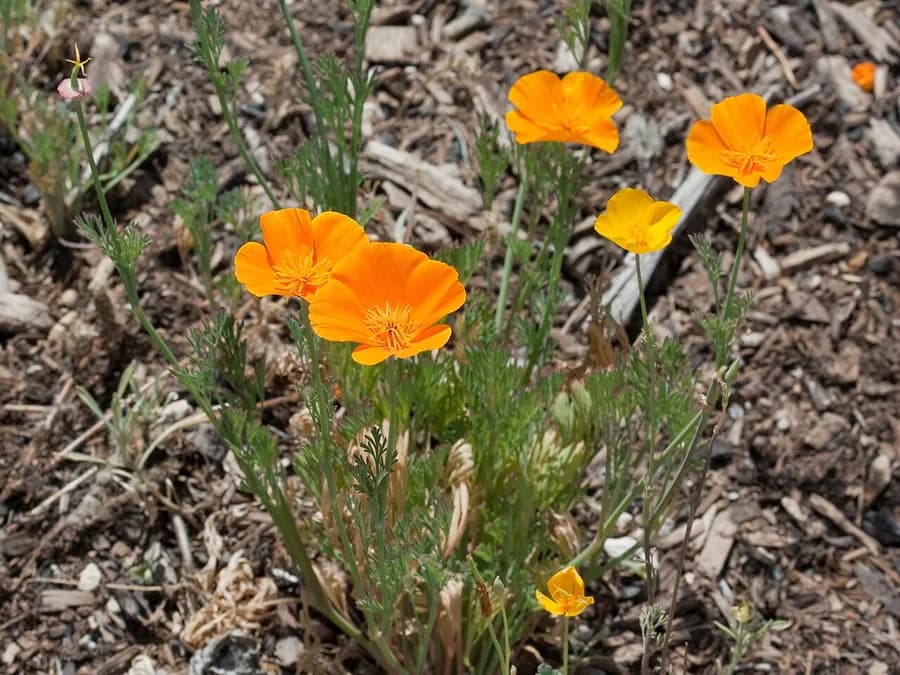
California poppy is native to dry, open ground and it behaves accordingly. Full sun is essential — in shade it stays leggy and refuses to open its flowers properly. The flowers themselves close at night and on overcast days, which is normal and not a problem.
Poor, sandy, well-drained soil produces the best plants. Rich soil produces a lot of blue-grey foliage and disappointing flowering, and wet soil rots the taproot outright. If you have been improving a bed, this plant belongs somewhere else.
Water it in to get it germinated, then largely leave it alone. Established plants are drought-tolerant, and overwatering is the most likely way to lose them.
Self-seeding and what happens next year
Left alone, California poppy sets seed prolifically and comes back. In mild climates it can behave as a short-lived perennial; in colder regions it dies with the frost and returns from self-sown seed.
The seed pods are long and narrow and split explosively when ripe, flinging seed some distance from the parent. That is excellent if you want a naturalised drift and inconvenient if you wanted it in one tidy patch.
If you want to collect seed, watch the pods and pick them when they turn from green to tan but before they split, then finish drying them in a paper bag so the seed is caught when they do.
Traditional use, stated carefully
California poppy has a history of use in Californian folk practice, historically associated with rest and calm. It is the state flower of California and is widely grown ornamentally.
That history is not clinical evidence, and nothing here should be read as a claim that the plant treats, prevents or cures anything. It is worth noting that this species is a relative of the opium poppy but is not the same plant and does not contain the same compounds.